Aitta - Machine Learning Inference on LUMI Supercomputer
Aitta is a machine learning inference service that allows you to interact with large open models directly on the LUMI Supercomputer hardware without dealing with any of the technical details. You just send your inference request to an OpenAI compatible API - Aitta takes care of allocating resources from the supercomputer scheduling system (Slurm), loading the model and forwarding the request to the designated compute node.
Aitta provides an API for programmatic access which allows you to develop or test applications that require inference as a service component. It also enables you to perform automated evaluation of a model you are interested in. Additionally, Aitta provides a web frontend with basic chat interfaces that you can use to interact with the models directly.
Aitta is currently available for all users with access to the LUMI supercomputer. You need a valid CSC account with access to at least one active LUMI project.
What can I use it for?
Aitta is intended for research and development, including for example
- exploring capabilities of models,
- performing research that relies on models to generate or evaluate data,
- building applications that rely on inference as a part of their functionality.
However, Aitta is entirely reliant on the LUMI supercomputer hardware and scheduler and thus there is no guarantee for availability of a particular model at any given time. In particular this means that Aitta is unsuited as a production-level inference service. You should not use it to deploy applications that require assured availability.
Currently Aitta includes generative Large Language Models (LLMs) and text embedding models. Image input is supported for LLMs with vision capability. Further multimodal capabilities are planned for the future.
Web Frontend - Interactive chat usage
Usage
-
Visit the web frontend at aitta.csc.fi. Click the "Log In" button at the top to log in. Go through the usual CSC authentication flow.
-
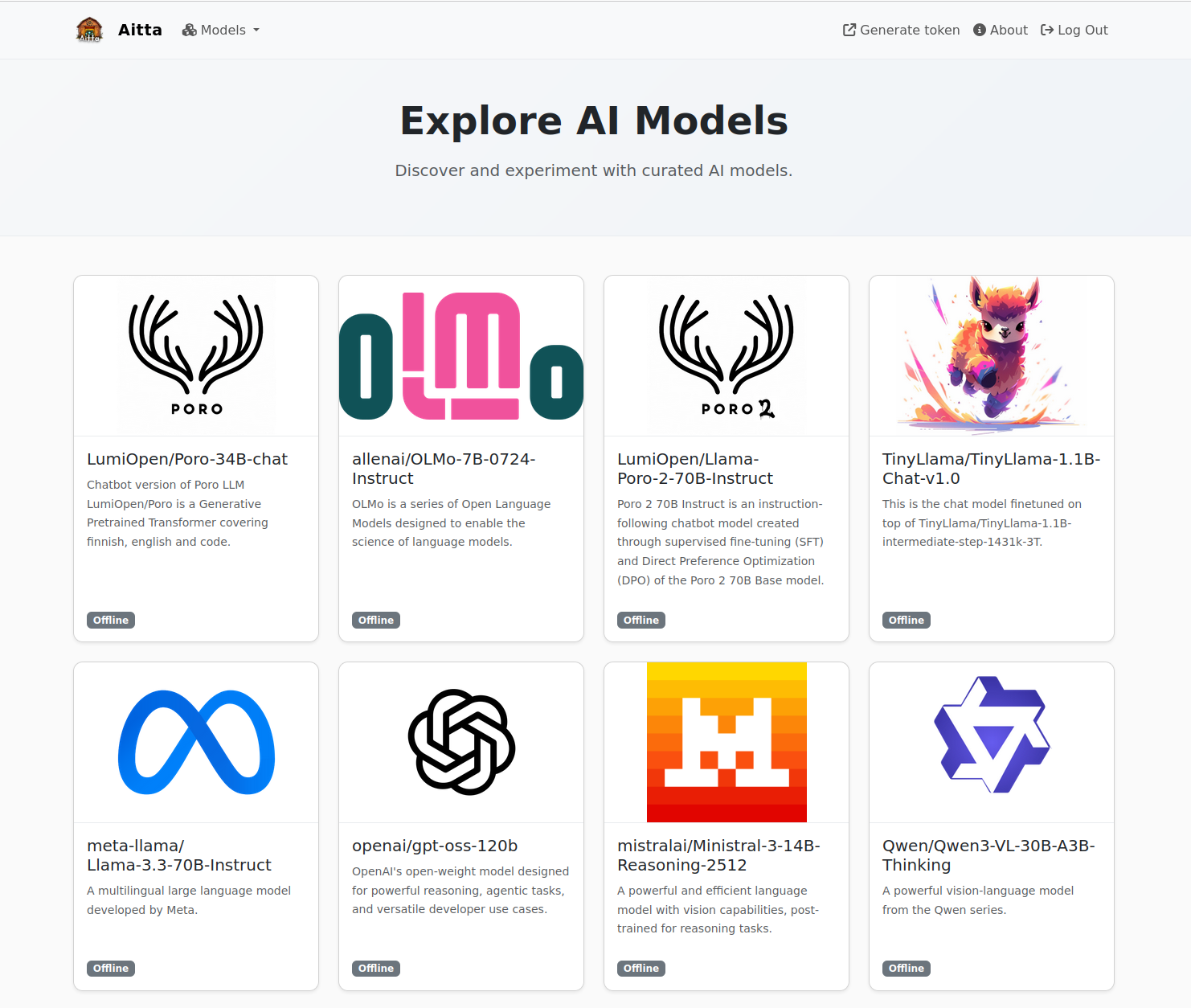
After you have logged in, you will see a page that shows the available models and whether they are currently online or not. Click on any model to open a chat view.
-
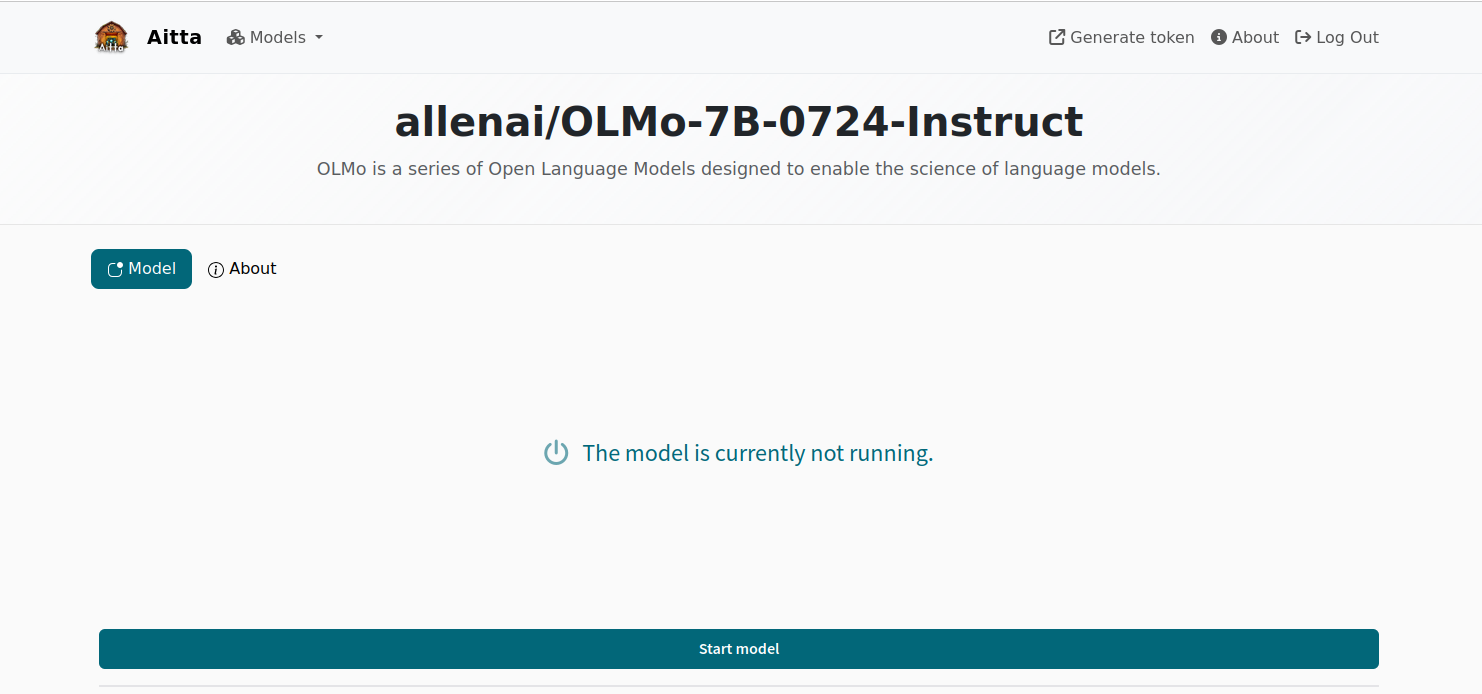
If the model is not currently running, you cannot interact with it. Click the "Start model" button to request that Aitta starts the model on the LUMI supercomputer hardware.
-
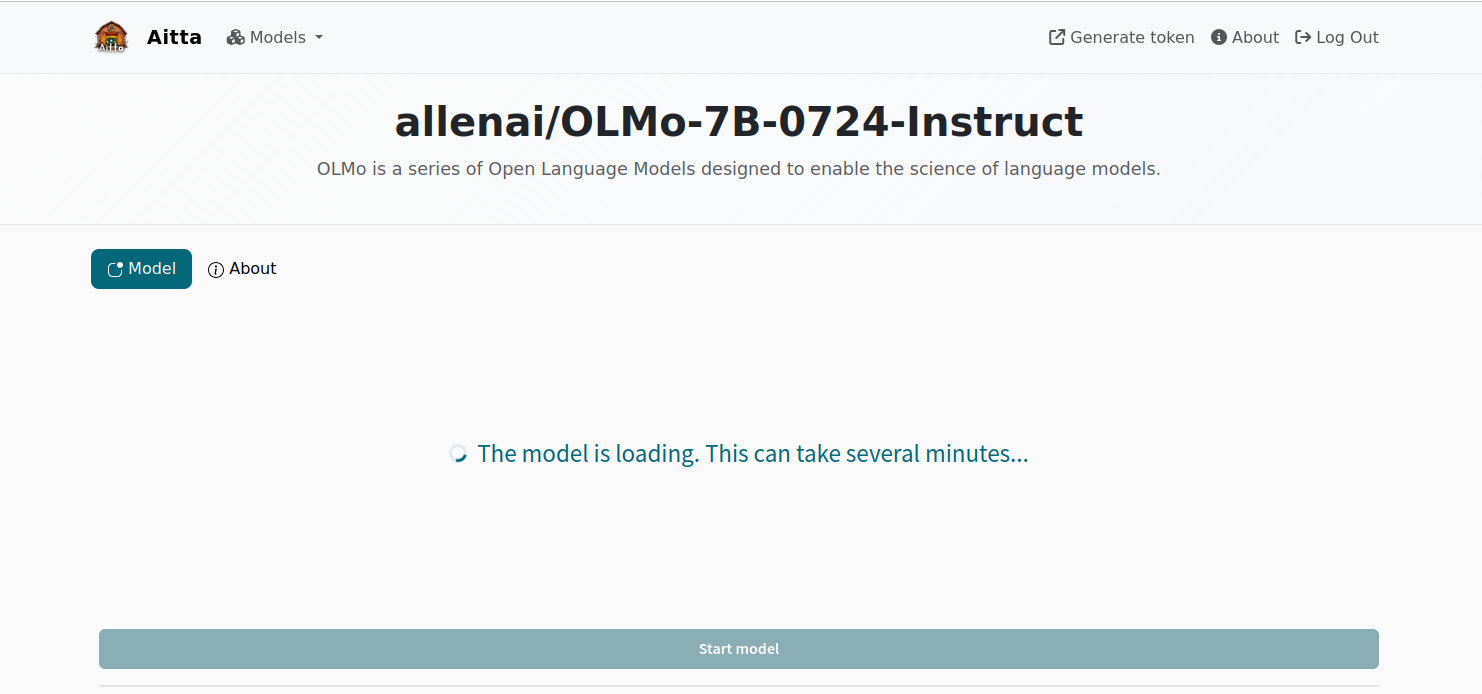
You will have to wait a while until the model becomes available. The web frontend will display messages "Waiting for computing resources..." or "The model is loading. This can take several minutes..." (when compute resources were allocated and the model is loaded from storage to GPU memory) to indicate the current status. The "Start model" button cannot be interacted with during that time.
-
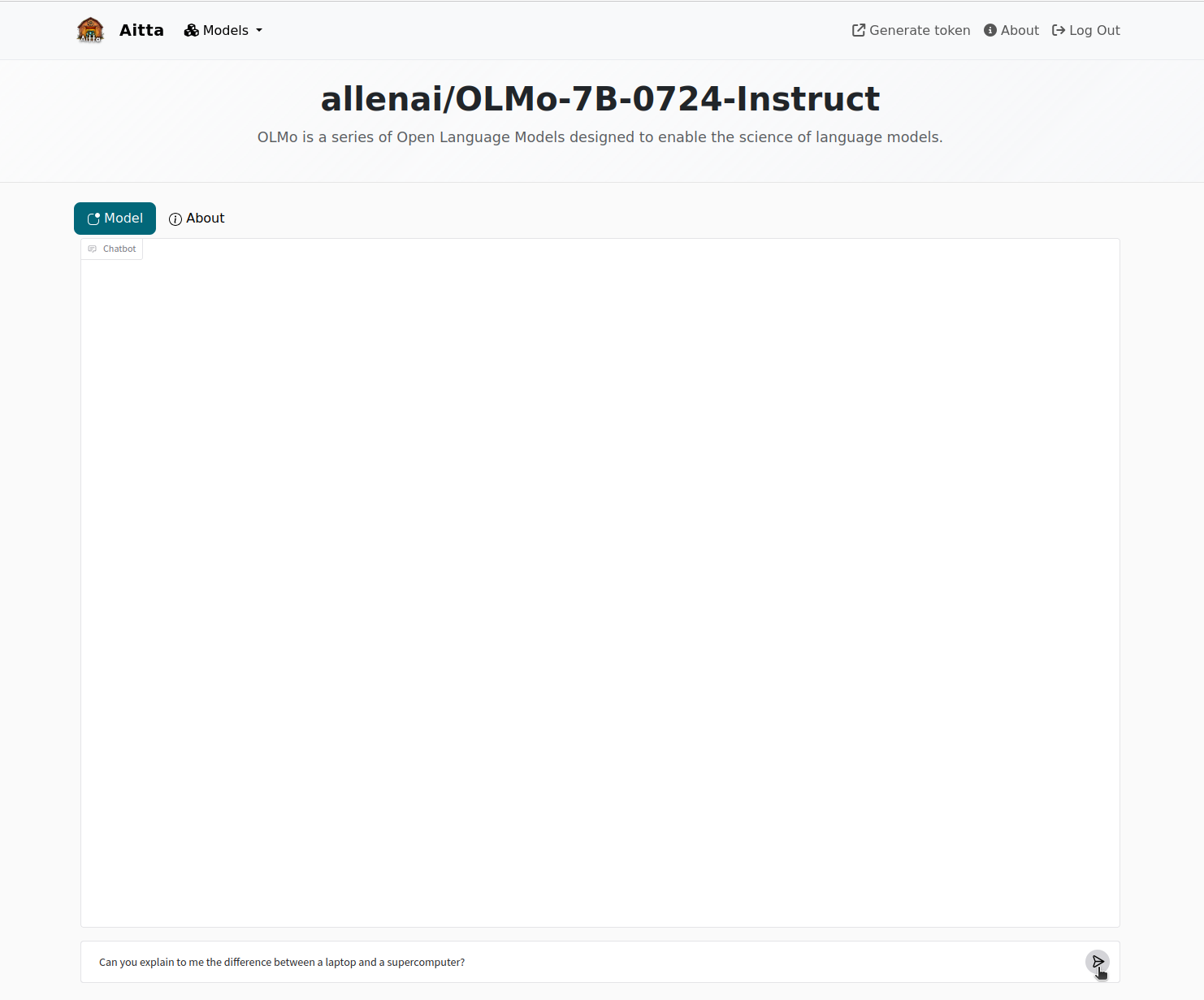
When the model is ready, the web frontend will display a chat window. As in similar chat applications, you can enter your messages to the model in the input field at the bottom. Click the button that looks like an arrow to send your message. If you selected a model that was indicated as "Online" on the model selection page, you will see this page immediately and do not have to start the model.
-
Aitta will forward your message to the model and stream the response back to the web frontend where it will appear in the chat window. Every message has associated buttons which you can use to 1) copy the message to the clipboard, 2) repeats the previous request to see if the model generates a better response message or 3) remove the last request and response (the last request will be copied into the input field, where you can modify it).
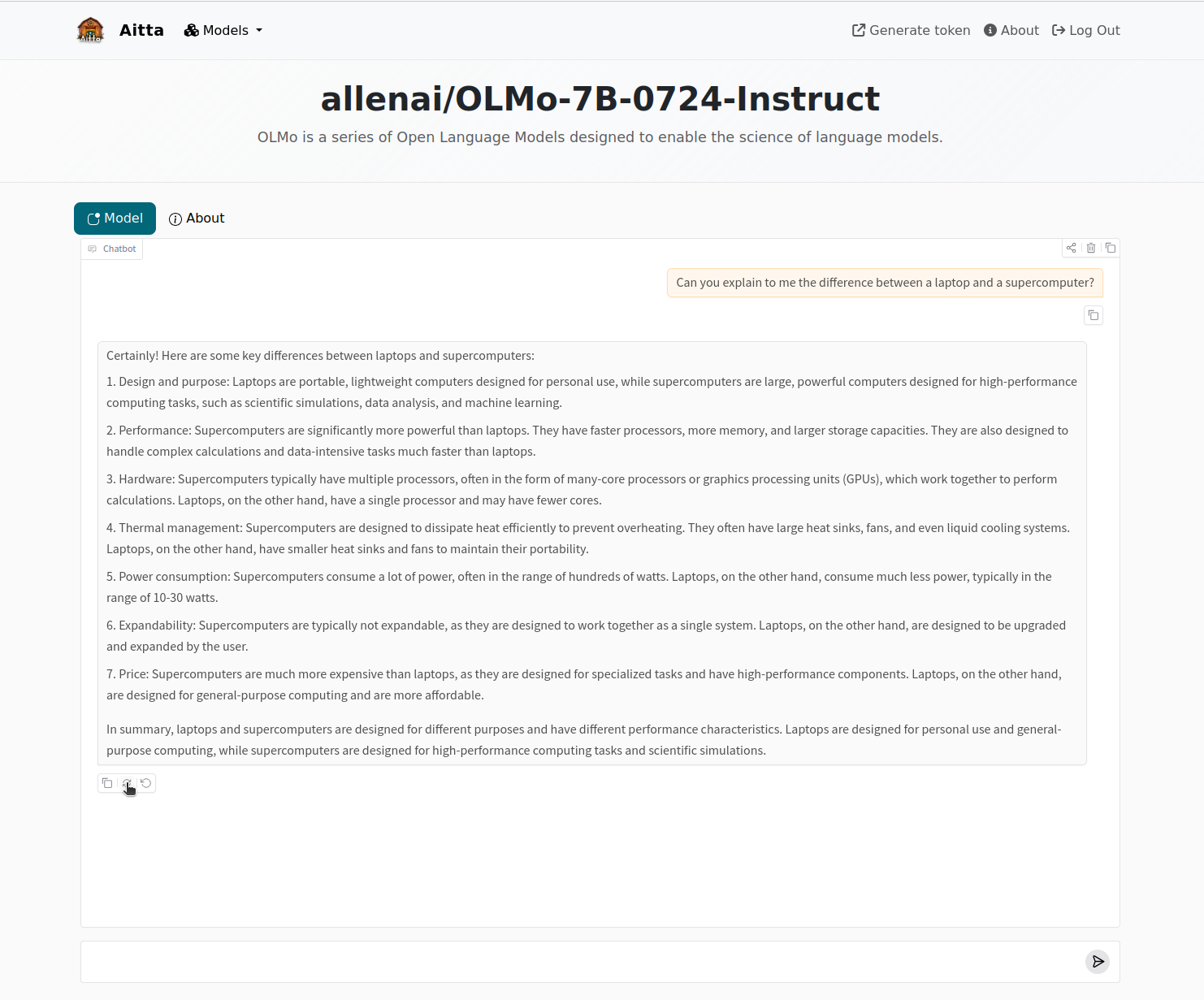
-
You can switch between different models at any time. You can hover over the "Models" text at the top of the page to see a dropdown menu of all models in the system. Click on any model to go to the respective model page. Alternatively, you can click on the Aitta logo to return to the model selection page.
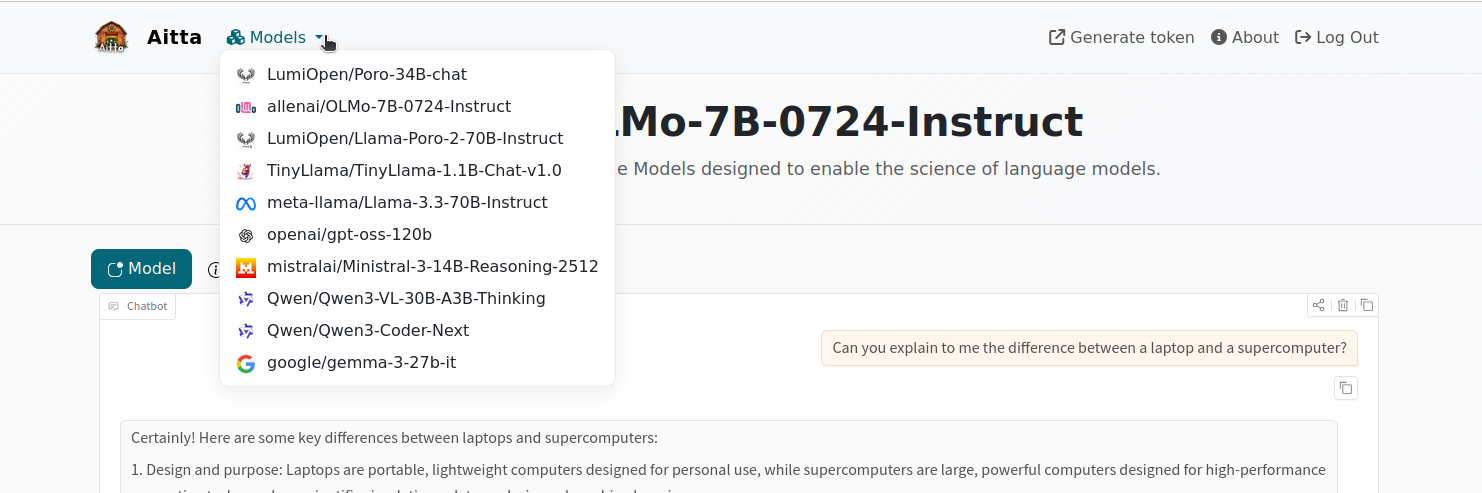
-
When you are down, you can log out via the "Log Out" button at the top right corner or simply leave the page. You do not need to explicitely shut down any model you were using.
Limitations
The web frontend is only a basic chat interface with no additional features. The entire chat history is kept in your browser. If you leave the page, the conversation is deleted and can not be recovered. Furthermore, if the model becomes unavailable during the conversation, the frontend will return to show the message that the model is currently not running. This also results in the chat history being lost. While Aitta tries to ensure that a model is always running when you are actively using, it can happen that the current allocation of resources expires before Aitta is able to obtain a new allocation.
The frontend also performs no automatic compaction of the history. If the length of the conversation exceeds the capabilities of the underlying model, it will stop responding and you may encounter an error message.
API - Programmatic access
Aside from the web frontend, Aitta offers a RESTful API for programmatic access via HTTP at aitta-api.csc.fi. You can use it either with existing clients and libraries you want to explore or to develop your own application requiring ML inference services.
Get your access token
To access the API you need to provide an access token to authenticate to the system. The token is provided via the HTTP Authorization header in each request:
Authorization: Bearer your-token-goes-here
You can obtain an access token from aitta-auth.csc.fi/myToken (or by following the "Generate token" link from the web frontend after you logged in) if you have a valid LUMI computing project. This will immediately start a (new) login sequence with CSC's authentication system. After completing the authentication you will see a website displaying your access token for Aitta. Alongside the access token itself, you will see the LUMI projects included in its access scope as well as the duration of validity for the token. This token is meant for day-to-day interactions and is valid for 24 hours by default. When the token expires, you need to visit the same page again to generate a new token.
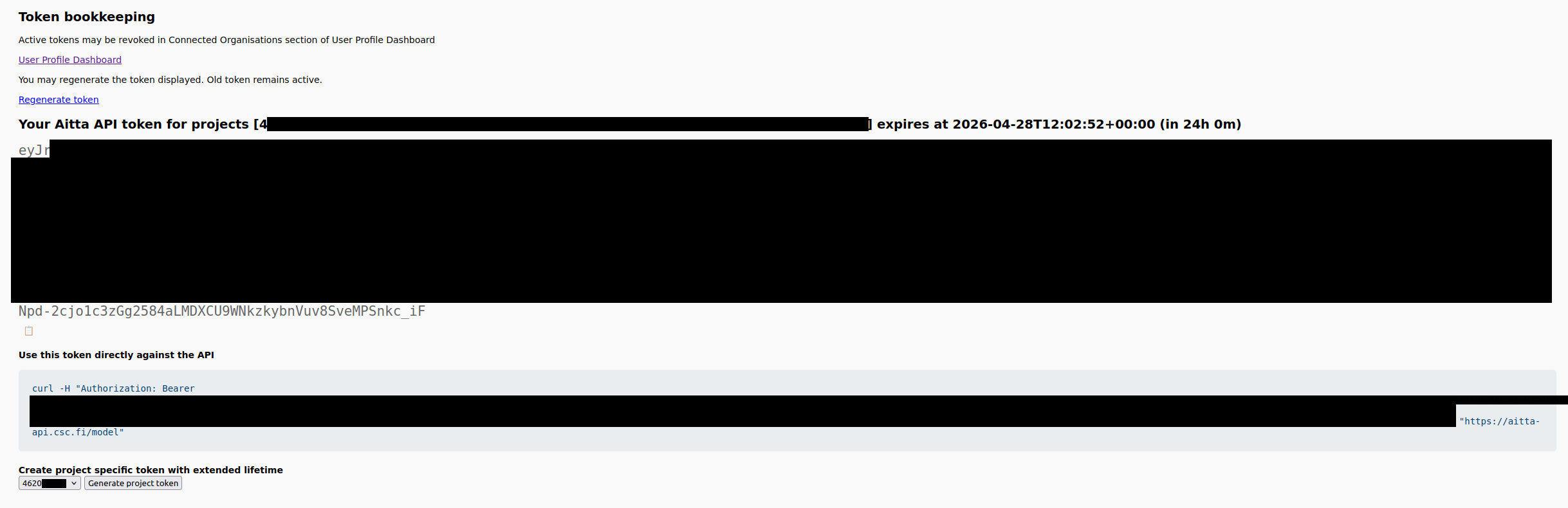
To enable use in long running client applications, you have the option to create a longer lived access token by narrowing. To do so, you can use the drop-down menu shown at the bottom of the page to select one of your projects and press the "Generate project token" button. After confirming, the website will show the project specific token at the bottom of the page. This token is currently valid for 90 days.
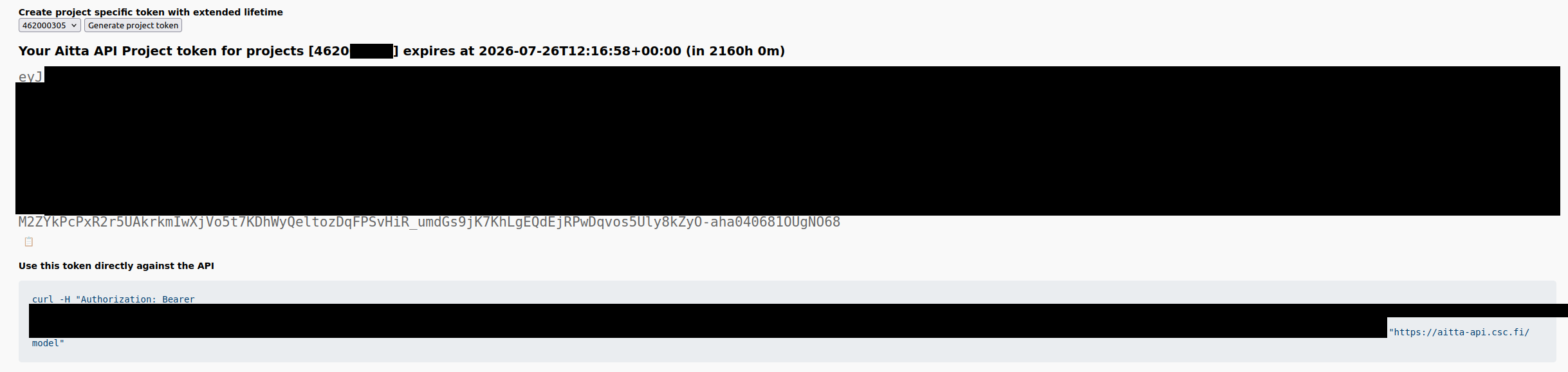
Currently there is no relevance to the project scopes of the tokens as all provided models are available for every authenticated user. However, in the future we plan to use the project information for billing and to restrict access to models a user may upload themselves.
Inference in Python
Aitta offers a drop-in replacement for an OpenAI-compatible API which is possible to use through various client libraries.
The vanilla OpenAI client
The official openai client can be used to interact with Aitta:
import openai

client = openai.OpenAI(
    api_key="< your token >",
    base_url="https://aitta-api.csc.fi/openai/v1"
)
chat_completion = client.chat.completions.create(
    messages=[ {
        "role": "user",
        "content": "Write a novel about Quantum Computing."
    } ],
    model="openai/gpt-oss-120b",
    stream=True
)
for chunk in chat_completion:
    if chunk.choices[0].delta.content is not None:
        print(chunk.choices[0].delta.content, end='', flush=True)
LangChain
LangChain is a popular library for creating LLM applications. Aitta can be used as an OpenAI-compatible endpoint as follows:
from langchain_openai import ChatOpenAI

llm = ChatOpenAI(
    api_key="< your token >",
    base_url="https://aitta-api.csc.fi/openai/v1",
    model="openai/gpt-oss-120b"
)
messages=[ {
    "role": "user",
    "content": "Write a novel about Quantum Computing."
} ]
llm.invoke(messages)
aitta-client
The PyPI package aitta-client contains functions for interacting with the non-OpenAI parts of the Aitta API (e.g. authentication, listing models and workers etc.). It is currently under development, but not required for running inference.
API reference
This section gives a broad overview of the available API functionality. To check a detailed reference for parameters and example usage, refer to the automated Swagger API reference at api-aitta.csc.fi/docs.
Responses from the Aitta API are typically JSON objects following the Hypertext Application Language (HAL) specification, which in every response includes URLs to further endpoints relevant to the requested resource. This allows you to write client code that follows the URLs linked from the responses based on semantic names for resource endpoints instead of hardcoding URLs in your code.
OpenAI compatible inference
The Aitta API offers OpenAI API compatible endpoints with a base url of https://aitta-api.csc.fi/openai/v1. Currently endpoints for chat completion and embedding inference requests are implemented. Refer to the corresponding OpenAI API specification for available parameters.
- aitta-api.csc.fi/openai/v1/embeddings: https://developers.openai.com/api/reference/resources/embeddings/methods/create
- aitta-api.csc.fi/openai/v1/chat/completions: https://developers.openai.com/api/reference/resources/chat/subresources/completions/methods/create
Note that these endpoints do not include HAL resource links as that would be incompatible with the OpenAI API.
Model information
The API exposes details about available models. You can get a list of available models from the aitta-api.csc.fi/model. The JSON object contains a field with a list of model ids paired with a URL to retrieve more detailed information about each model. Model ids generally follow the format model-vendor/model-name as on e.g. Huggingface. Model information links currently replace the / with a ~ for technical reasons, so to get information about a model, you would need to query aitta-api.csc.fi/model/model-vendor~model-name. The following listing shows an example response:
{
  "_links": {
    "item": [
      {
        "href": "/model/LumiOpen~Llama-Poro-2-70B-Instruct",
        "name": "LumiOpen/Llama-Poro-2-70B-Instruct"
      },
      {
        "href": "/model/openai~gpt-oss-120b",
        "name": "openai/gpt-oss-120b"
      }
    ],
    "self": {
      "href": "/model",
      "name": "self",
      "title": "This link refers back to the resource itself."
    }
  }
}
The response of the model information endpoint is a JSON object containing a description of the model as well as a list of the models capabilities, indicating which inference endpoints are supported for the model. It also includes a list of URLs relevant to the model, including e.g. the OpenAI compatible inference endpoints the model supports as well as the URL of the endpoint listing currently active workers for the model. An example response for the openai/gpt-oss-120b model looks like the following:
{
  "id": "openai/gpt-oss-120b",
  "description": "OpenAI's open-weight model designed for powerful reasoning, agentic tasks, and versatile developer use cases. This variant is recommended for production, general purpose, high reasoning use cases that fit into a single 80GB GPU (like NVIDIA H100 or AMD MI300X) (117B parameters with 5.1B active parameters).",
  "capabilities": [
    "openai-chat-completion"
  ],
  "_links": {
    "self": {
      "href": "/model/openai~gpt-oss-120b",
      "name": "self",
      "title": "Refer back to the resource itself."
    },
    "metadata": {
      "href": "/model/openai~gpt-oss-120b/metadata",
      "name": "metadata",
      "title": "Model metadata as stored in the database"
    },
    "openai-chat-completion": {
      "href": "/openai/v1/chat/completions",
      "name": "openai-chat-completion",
      "title": "An OpenAI compatible endpoint for generating chat completions. See https://platform.openai.com/docs/api-reference/chat/create for usage. Currently not all features are supported."
    },
    "worker": {
      "href": "/worker/openai~gpt-oss-120b",
      "name": "worker",
      "title": "Obtain a list of all workers hosting the model."
    },
    "collection": {
      "href": "/model",
      "name": "collection",
      "title": "Obtain a list of all models served by the API."
    },
    "openai": {
      "href": "/openai/v1",
      "name": "openai",
      "title": "Base URL for OpenAI compatible endpoints. Currently not all endpoints or features are supported."
    }
  }
}
Worker information
The /worker endpoint can be used to query which workers (inference engine instances serving a particular model) are currently running. This can be used by your application e.g. to inform the user about possible delays when a worker needs to be started, or to dynamically pick a currently running model to avoid the delay.
{
  "_links": {
    "self": {
      "href": "/worker",
      "name": "self",
      "title": "This link refers back to the resource itself.",
      "method": "GET"
    },
    "item": [
      {
        "href": "/worker/openai~gpt-oss-120b/PKA0",
        "name": "openai/gpt-oss-120b-PKA0",
        "title": null,
        "method": "GET"
      },
      {
        "href": "/worker/Qwen~Qwen3-Coder-Next/u31z",
        "name": "Qwen/Qwen3-Coder-Next-u31z",
        "title": null,
        "method": "GET"
      }
    ]
  }
}
The worker name includes the model name.
Maintenance downtime information
The /status endpoint returns information about Aitta availability: either "OK" or information about a maintenance break, for example:
{
  "begin": "2026-05-07T13:37:48Z",
  "end": "2026-05-07T14:07:48Z",
  "reason": "Filesystem problems on LUMI, see: https://lumi-supercomputer.eu/lumi-service-status/information-lustre-filesystem-performance/"
}
The /downtimes endpoint returns information about all current and upcoming maintenance breaks that are currently scheduled.
Rate limits
The amount of requests sent per minute by an individual user is limited. In case the API returns the status code 429 Too many requests, you can resume the usage after a minute. There are currently no longer-term limits.